I learned to ride a bicycle in the car park of Rex Motel in Ventura, California. It was a reasonably forgiving place to do so: flat, rarely busy enough to present much danger, and with the grounds of the middle school next door available once I had acquired sufficient confidence to leave the premises. Rex Motel was not somewhere we stayed. My family owned it, and for most of my childhood it was simply one of the places I thought of as home.
The motel stands at 2406 East Thompson Boulevard, on what was once the main coastal road through Ventura towards Los Angeles. The City of Ventura dates it to 1938; a Los Angeles Times article from 1993 says 1939, which seems a tolerable margin of error for a building approaching its ninetieth birthday. It had twenty rooms, arranged in the low, U-shaped form that once lined American highways, their doors opening almost directly onto the spaces where guests parked their cars. Ventura now lists Rex Motel as a historic site, one survivor from a stretch of roadside architecture that ranged from Mission Revival to Art Moderne.
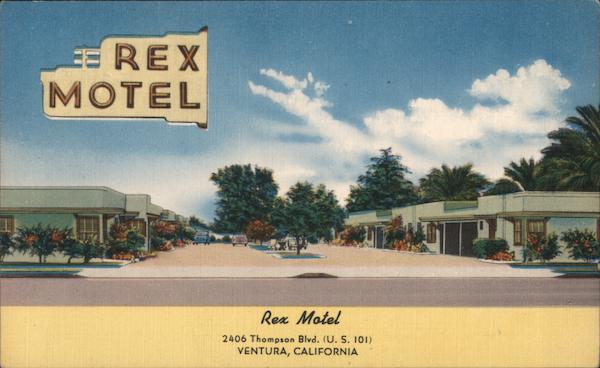
The motel itself is only slightly older than the word. In 1925, the Milestone Mo-Tel opened further up Highway 101 in San Luis Obispo, its architect Arthur Heineman contracting "motor hotel" to name a new form of accommodation for a country reorganising itself around the car. Ventura took longer to adopt the terminology. Its telephone directory continued to list auto courts, then motor courts, before finally settling on motels in the 1950s. There were competing names. "Autel" was one. History, on this occasion, showed some judgement.
The architecture followed the automobile. Early motor courts offered travellers something between a campsite and a hotel: a room beside the road, a bathroom, somewhere to leave the car and very little distance between arrival and bed. By the middle of the century, Thompson Boulevard and East Main Street had become a catalogue of the type. There was the Mission Bell, the Ocean View, the Topper, the White Caps, the Viking and Rex Motel. The Ocean View had, according to the Los Angeles Times, a fine Art Moderne entrance and an ocean view that had become largely theoretical.
Then the road moved. Highway 101 once carried traffic directly along Thompson Boulevard; in 1960 the freeway bypassed it. Larger chains gathered around the new interchanges while the small independent motels remained on a road motorists no longer had to use. Some disappeared. Others changed clientele or purpose. By the early 1990s, the old motel row was sufficiently endangered for the Los Angeles Times to write about its survival.
The LA Times published this article on 17 June 1993, a few weeks before I was born. It describes the owner of Rex Motel, Paul Patel, who had by then run the motel for seventeen years. It also describes something that had become increasingly common along the American roadside: older independent motels passing into the hands of immigrant families. When Patel's brother-in-law came home from college for the summer, the reporter noted, he put down his physics books and picked up a broom.
Paul is my uncle Pankaj. The physics student is my uncle Kintesh.
My family's route to California ran from India through East Africa, with different branches eventually reaching Britain and the United States in the 1960s and 70s. Their story formed part of a much larger Gujarati migration into the American motel trade, but they did not arrive at Rex Motel as owners. They began by working there, learned the business from the rooms upwards, became managers and, after years of work and saving, were eventually able to buy it themselves.
The neat retrospective language of immigration, enterprise and economic mobility disguises how physical the work was. My family cleaned the rooms themselves. They scrubbed each toilet, changed the sheets, made every bed and cleaned up whatever the previous guest had left behind. They answered the bell twenty-four hours a day, dealt with blocked drains, broken appliances, guns, prostitution and whatever else arrived with the next room key, then began again the following morning. They did this day in and day out, not for a summer but for decades, until recent retirement.
A month after the newspaper article, I was born at Community Memorial Hospital, a few blocks away. Before I have any memory of Ventura myself, I have one inherited from my mother: while pregnant with me she walked along Ventura beach every day. I grew up in London, which is home, but almost every break from school brought me back to California. Summers, Christmases, Easter holidays and many of the smaller gaps in between were spent in Ventura, year after year until I was eighteen. My cousins were at Rex Motel. We played around the motel and at the school next door. I learned to cycle there, and to shoot a lay-up. It was during this period I was converted to the church of Kobe. For an LA kid in the 90s and early 00s, there was but one god and he wore the purple and gold of the Lakers.
A motel is, by design, a place for brief encounters. Most people arrived, slept and left. But not everyone did.
Larry lived in the same room at Rex Motel for decades. He was a retired physicist who had studied at Berkeley and, over time, became less a customer than part of the collection of people around the motel. He had an influence on my older cousin, who grew up at Rex Motel and later went on to study physics at Berkeley herself. A motel is supposed to offer anonymity; it is difficult to remain anonymous somewhere for thirty years.
Towards the end of Larry's life he became ill and was admitted to Community Memorial, the same hospital in which I had been born. My uncle Pankaj visited him every day. When I was back in Ventura that summer, I went too.
My own California was built from equally ordinary things. There was Lake Casitas, Corrales, the small roadside Mexican place serving what remains my favourite food in the world; Catalina Island, home to some of the largest underwater giant kelp forests towering below the coastline; the pier; Baskin-Robbins; the mall; Universal Studios, the now closed Falafel King in downtown LA, and weekly trips to Costco. Memory is not always especially discerning. Proust had his madeleine; a surprising amount of my childhood can be recovered from the smell of Costco pizza and churros.
Mostly, though, there was the beach. We walked along it constantly, towards the pier and back. It was not an excursion in the way the beach can be elsewhere. The Pacific simply occupied one edge of the city, appearing at the end of roads and beyond car parks, while the dry hills rose behind the other.
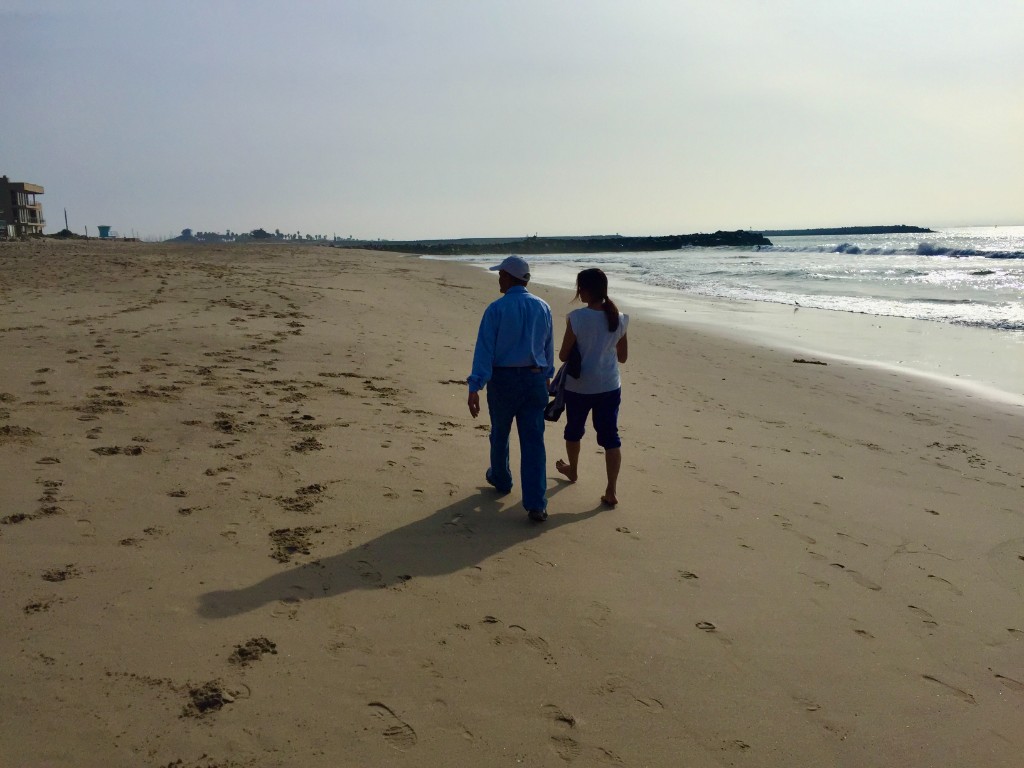
For most of my childhood Ventura had the peculiar quality of being completely familiar while never becoming quite ordinary. I did not live there continuously, and so each school holiday involved returning to the same rooms, roads, relatives and routines after enough time away for them to become visible again. Rex Motel remained the fixed point through all of it.
After starting university, my trips to the US centred mostly around the east coast for work. Meanwhile my family has moved from Ventura, mostly to nearby Camarillo, Orange County or further afield. Rex Motel remains on Thompson Boulevard. My family has now owned it for around half its existence, long enough for their tenure to have become part of the history of a building they first knew as employees. The freeway diverted the traffic, neighbouring motels disappeared or changed, and Ventura eventually decided that the remnants of its old roadside architecture were worth preserving.
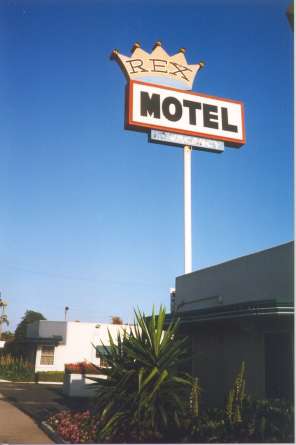
Rex Motel still has twenty rooms. Guests still arrive from the road. Beds are still made, rooms are still cleaned and, late enough at night, somebody still rings the bell looking for somewhere to sleep.
Nearly ninety years after it opened, the motel remains what it was designed to be: a temporary home for people passing through.
For some of us, it lasted rather longer.